


Security for AI agents must be enforced by the infrastructure underneath them, not only in the model.
Supermicro is joining the Open Secure AI Alliance (OSAIA) to help connect open defenses to infrastructure customers already deploy. OSAIA builds and shares an open defensive stack of AI models, tools, and techniques intended to strengthen cyber defense and secure software and AI agents. Its emphasis on open systems is practical: defenders need capabilities they can inspect, adapt, test, operate on infrastructure they control, and continue using as models, vendors, and deployment environments evolve.[1]
On September 14, 2026, the Alliance moved to the Linux Foundation, establishing a neutral home for industry, researchers, and government participants to collaborate on open AI security and collective defense.[1][2] Supermicro’s participation comes amid a broader push across government and industry to advance AI while strengthening security. The Administration’s June 2026 AI innovation and security action and the September 29 voluntary accord announced by President Trump and leaders from major AI companies both emphasize stronger safeguards alongside continued AI development.[3][4]
Together, these efforts reflect growing momentum toward a common goal of advancing AI while strengthening the safeguards required for responsible deployment. OSAIA provides an open, collaborative framework for translating that goal into practical defenses across the AI stack. As agents gain access to enterprise data, tools, APIs, code execution, and long-running workflows, security must extend beyond the model. Supermicro believes security should enable AI adoption by giving organizations the visibility, control, accountability, and recovery capabilities needed to deploy with confidence.
Security must extend across the whole agent stack
OSAIA starts from a simple premise that an AI agent is more than a language model. Real security depends on the complete operating system around the agent—model, context, orchestration, identity, policy, enforcement, recovery, and infrastructure. The Alliance organizes the problem into seven layers:[1]
1. Model & Inference — reason, generate, predict, and explain.
2. Agent & Context — plan, use memory, select tools, and delegate.
3. Guest Harness — orchestrate work and request an action.
4. Policy, Identity & Governance — verify state and apply rules, budgets, permissions, and approvals.
5. Enforcement — allow, narrow, or block actions at the affected system.
6. Containment & Recovery — isolate, remove access, stop, roll back, and recover.
7. Trusted Foundation — provide hardware identity, isolation, protected keys, and evidence.
Layer 7 is where Supermicro will make its clearest contribution today. The trusted foundation anchors the higher layers in platform identity, firmware integrity, isolation, protected keys, and infrastructure evidence generated outside the agent runtime. Supermicro will also contribute integration experience at the boundaries with enforcement and containment, where software policy has to become an operational control.
From agent runtime safety to an open, full-stack model
Supermicro’s September 28 article on the NVIDIA Open Agent Safety Platform described a layered approach to agent safety, beginning with NVIDIA OpenShell for sandboxing and runtime policy controls.[5][6] Announced by NVIDIA on October 21, the NVIDIA OpenShell Reference Architecture for Safe AI Agents takes the next step, showing how runtime policy controls and infrastructure-level protections can be composed into a complete system. It includes:
- NVIDIA OpenShell secure runtime for agent governance outside of the AI model, enforcement of zero-trust agent access and permissions, and deployment for fleets of agents
- NVIDIA Sentry, built on NVIDIA DOCA and running on NVIDIA BlueField-4 DPUs, protects agents at runtime
- The NVIDIA Vera Rubin platform for running large language models, including proprietary models and open models such as NVIDIA Nemotron
- NVIDIA Vera CPUs for operating agent harnesses and NVIDIA OpenShell secure agent runtime
- NVIDIA BlueField DPUs in Vera and Vera Rubin systems observe the agent behavior and enforce policy with NVIDIA Sentry.
Supermicro is supporting the OpenShell Reference Architecture in the Supermicro SuperCloud Software Suite, the company’s integrated software platform for managing AI and data-center infrastructure.[7] It spans multi-tenant bare-metal control, automation, composable infrastructure, and developer environments, delivering validated, end-to-end workflows—from firmware and provisioning through GPU clusters, networking, and lifecycle operations—so customers can deploy and operate complex AI systems with consistent security, governance, and operational rigor. This software integration provides a practical path for deploying OpenShell on Supermicro infrastructure and brings agent runtime policy closer to the tools customers use to manage and operate their systems. Combined with Supermicro’s platform security capabilities, it demonstrates how agent-level software controls and trusted infrastructure can work together as part of a broader security architecture.
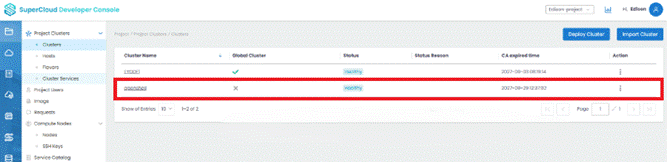
OpenShell support within Supermicro SuperCloud Software Suite
NVIDIA Sentry extends the same model with a unified software framework that runs on NVIDIA BlueField. It adds independent, out-of-band monitoring, attested telemetry, and hardware-backed enforcement outside the agent runtime. Operating from an isolated trust domain, NVIDIA Sentry can monitor agent behavior and quarantine or stop an agent that attempts to move beyond its policy boundaries. Together, OpenShell and NVIDIA Sentry demonstrate why agent security benefits from controls and evidence that are independent of the workload.[6]
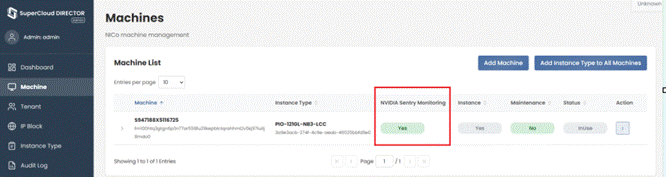
NVIDIA Sentry Monitoring within Supermicro SuperCloud Software Suite
OSAIA broadens this focus through open collaboration and emphasizes that defenses should remain portable as models, vendors, and infrastructure change. Supermicro brings deep experience in platform security spanning multiple product generations. Its role in the Alliance focuses on infrastructure principles and validation methods rather than tying the security model to one CPU, accelerator, or deployment architecture.
Where Supermicro will contribute
Supermicro’s near-term contribution spans both software integration and trusted infrastructure. Through its work to support OpenShell within SuperCloud Software Suite, Supermicro can help make agent runtime controls easier to deploy and operate on Supermicro systems. At the infrastructure layer, Supermicro can map OSAIA’s Trusted Foundation requirements to security capabilities already documented across its product portfolio and extend that foundation through repeatable system validation.
Integrate agent controls with infrastructure operations. Supermicro’s OpenShell work demonstrates how the company can contribute above the hardware foundation by connecting agent runtime policy with infrastructure deployment and management. This creates an opportunity to validate how software policy, platform controls, telemetry, containment, and recovery operate together as a complete system.
|
Foundation control |
What it establishes |
Supermicro contribution |
|
Silicon root of trust |
A hardware-rooted starting point for platform trust |
Anchor platform identity and firmware trust on supported systems. |
|
Secure boot |
Only trusted boot components are allowed to execute |
Help establish known-good platform state before higher-level agent controls run. |
|
Signed firmware |
Authenticity and integrity of firmware updates |
Protect firmware supply and update paths. |
|
Secure update |
Controlled update process |
Support lifecycle security without treating deployed infrastructure as static. |
|
Recovery |
Return to a known-good state after failure or compromise |
Strengthen containment and operational recovery. |
|
Attestation |
Evidence of hardware/firmware state |
Provide infrastructure evidence independent of agent-reported behavior. |
These capabilities apply only where listed for supported systems in Supermicro’s public security-features documentation.[8]
Validate the stack as a system. The seven OSAIA layers will often come from different vendors and open-source projects. Supermicro’s Data Center Building Block Solutions® (DCBBS) model already integrates and validates complete infrastructure before deployment. That same discipline can be applied to AI security to test not only individual controls, but the boundaries between agent runtimes, identity, networks, storage, management planes, accelerators, and recovery workflows.[9]
Bring security into deployment, not after go-live. For agentic AI, the objective should be to validate the applicable foundation, enforcement, and containment controls as part of the production architecture rather than designing them after go-live. This is where Supermicro’s integration and factory-validation model can become valuable to the Alliance and to customers.
SAFE: turn incidents into reusable controls
Technology alone will not anticipate every failure. AI systems will make mistakes, security assumptions will sometimes prove wrong, and new interactions between agents, tools, infrastructure, and people will expose conditions that were not visible during design. OSAIA’s current Shared AI Findings Exchange (SAFE) RFC addresses what happens when defenses fail and how the ecosystem can learn quickly from incidents, strengthen controls, and reduce recurring risks.[10]
SAFE is proposed as an independent incident-learning and assurance initiative. Its mission is to confidentially collect and analyze AI incidents and near misses, promptly inform affected parties, and turn recurring failures into shared, evidence-based controls that reduce systemic risk. The proposal calls for representation from model developers, enterprise deployers, hosting and tool providers, researchers, critical-infrastructure operators, civil society, and government or standards bodies as non-controlling observers. It also explicitly states SAFE should operate independently so no single vendor or industry segment controls its findings.[10]
From an incident to a reusable control
The most important concept in SAFE is the engineering feedback loop: preserve the evidence, identify which control failed, understand the system conditions that allowed it, reproduce the failure, define the required defensive outcome, verify the fix, and then share reusable protections where disclosure is safe.
The current RFC proposes preserving prompts, traces, tool calls, identities, permissions, credentials, configurations, model and safeguard versions, human intervention events, created or modified artifacts, detection and containment actions, and a complete incident timeline. It also calls for reviews across the complete operating stack, including the model, instructions, safeguards, tools, execution environment, monitoring, human operations, and supply chain.
The goal is not another incident database. SAFE proposes turning lessons into verifiable defensive recommendations with a required outcome, minimum control, acceptable alternatives, a reproducible verification method, retained evidence, accountable owners, and implementation metrics. When appropriate, the resulting protections could be published as reusable tests, machine-readable policies, detection rules, reference configurations, and incident-response guidance.
Why infrastructure evidence matters
Agent security is difficult to investigate if the only telemetry comes from the workload being investigated. Platform identity, firmware measurement, attestation results, isolation or containment events, and management-plane timestamps can provide an independent evidence layer. That evidence can help establish what platform was running, what state it was in, when a control fired, and whether recovery actually occurred.
From membership to measurable contribution
Supermicro has a long legacy of security across multiple generations of products. By joining OSAIA and supporting NVIDIA’s OpenShell Reference Architecture, Supermicro will bring its infrastructure expertise, platform security experience, OpenShell and NVIDIA Sentry integration work through SuperCloud Software Suite, ecosystem relationships, and large-scale validation model to the Alliance’s shared mission. Supermicro can help connect open security principles to systems customers already deploy by strengthening the trusted foundation, bringing independent infrastructure evidence into incident learning, and applying system-level validation to enforcement and containment.
AI safety and security are shared responsibilities. No single model developer, security vendor, cloud provider, infrastructure company, or enterprise controls the entire agentic AI stack. The value of OSAIA is to make those layers work together through open interfaces, shared evidence, common tests, and verifiable controls. Supermicro is committed to doing its part and collaborating through OSAIA and across the broader ecosystem so the industry can continue moving AI forward at infrastructure scale with the trust, resilience, and accountability that responsible adoption requires.
Sources:
[1] Open Secure AI Alliance — mission, seven-layer stack, why open matters, SAFE overview; [2] Linux Foundation — Open Secure AI Alliance Joins the Linux Foundation to Build a Shared, Open Defense Stack for the AI Era (Sept. 14, 2026) https://www.linuxfoundation.org/blog/open-secure-ai-alliance-joins-the-linux-foundation-to-build-a-shared-open-defense-stack-for-the-ai-era; [3] The White House — Executive Order: Promoting Advanced Artificial Intelligence Innovation and Security (June 2, 2026). https://www.whitehouse.gov/presidential-actions/2026/06/promoting-advanced-artificial-intelligence-innovation-and-security/; [4] Reuters - Trump, AI CEOs sign voluntary safety pact, back data center expansion (Sept. 29, 2026) https://www.reuters.com/legal/government/trump-host-zuckerberg-anthropics-amodei-other-ai-titans-tuesday-2026-09-29/; [5] Supermicro — Supermicro Supports NVIDIA Open Agent Safety Platform: From Policy to Hardware-Backed Enforcement (Sept. 28, 2026), https://learn-more.supermicro.com/data-center-stories/supermicro-supports-nvidia-open-agent-safety-platform; [6] NVIDIA — NVIDIA Open Agent Safety Platform: A Reference for Continuous In-Silicon Agent Monitoring (Sept. 28, 2026), https://developer.nvidia.com/blog/nvidia-open-agent-safety-platform-a-reference-for-continuous-in-silicon-agent-monitoring; [7] Supermicro SuperCloud Software Suite, https://www.supermicro.com/datasheet/datasheet_SuperCloud_Software_Suite.pdf; [8] Supermicro — Security Features Descriptions / Security Center, https://www.supermicro.com/en/support/security-features-description; [9] Supermicro — Data Center Building Block Solutions® (DCBBS), https://www.supermicro.com/en/solutions/dcbbs; [10] Open Secure AI Alliance — Shared AI Findings Exchange (SAFE) RFC, https://github.com/OpenSecureAIAlliance/RFCs/blob/main/rfc-safe-proposal.md
Subscribe to Data Center Stories
By clicking subscribe, you consent to allow Supermicro to store and process the personal information submitted above to provide you the content requested.
You can unsubscribe from these communications at any time. For more information on how to unsubscribe, our privacy practices, and how we are committed to protecting and respecting your privacy, please review our Privacy Policy.