

The enterprise data center is changing. The next generation of infrastructure isn't simply designed to run applications—it is designed to generate intelligence.
For decades, enterprise data centers were built around a familiar model: servers process transactions, applications run business operations, and storage systems hold increasingly large volumes of data.
Artificial intelligence is changing that equation.
Generative AI and emerging agentic AI workloads demand fundamentally different levels of compute, networking, memory, power, cooling, storage, and software integration. The result is a new infrastructure model emerging across enterprises, cloud providers, and AI-focused organizations: the AI Factory.
An AI Factory is purpose-built to continuously transform data and compute into intelligence at production scale. And as AI moves from experimentation into everyday business operations, the infrastructure behind it is becoming a strategic consideration—not simply another IT investment.
A $870 Billion Shift — In Under Five Years
Omdia's latest forecast puts the global data center server market at $870 billion by 2030 — nearly triple its current size. The more striking number is the mix: by that point, approximately 83% of all server spend will be on accelerated computing. General-purpose compute becomes the niche choice.
Accelerated AI server revenue will grow approximately 47× between 2022 and 2030. This isn't an incremental upgrade cycle — it's a structural transformation of what the data center is for.

At the same time, agentic AI is emerging as an important enterprise priority, creating demand for infrastructure that can support increasingly sophisticated and autonomous workloads.
The question for technology leaders is no longer simply how many GPUs to buy.
It is how to build the infrastructure around those GPUs so AI can deliver sustained business value.
The Hard Part Isn't Just the GPU
Buying accelerators may be the most visible part of an AI infrastructure investment. It is far from the only challenge.
Production AI requires multiple infrastructure layers to work together—from high-performance networking and storage to power distribution, thermal management, orchestration, and software.
When those components aren't designed and validated as a system, organizations can encounter deployment delays, inefficient resource utilization, unexpected operational costs, and challenges moving AI projects from promising pilots into reliable production environments.
That makes integration increasingly important.
The AI Factory approach treats the infrastructure as a unified system, with compute, networking, cooling, power, software, and operational management designed to work together from the beginning.
The objective isn't simply to install more compute. It's to create an infrastructure engine capable of producing intelligence efficiently, reliably, and at scale.
From Infrastructure Components to an Integrated Factory
This shift is changing how organizations should think about AI infrastructure.
Rather than assembling individual technologies and solving integration challenges after the fact, enterprises can adopt validated architectures designed around the requirements of modern AI workloads.
The Supermicro AI Factory approach brings together NVIDIA's accelerated computing and networking technologies with Supermicro's expertise in system design, manufacturing, rack-scale integration, liquid cooling, validation, deployment, and its Data Center Building Block Solutions® (DCBBS).
The result is an approach designed to help organizations move more efficiently from infrastructure planning to production AI—while providing a foundation that can evolve as workloads, models, and computing requirements change.
But what does that look like in practice?
And what separates an AI Factory that can continuously generate value from infrastructure that simply provides a large amount of computing capacity?
A New Infrastructure Playbook
Those questions are becoming increasingly important as enterprises move beyond AI experimentation.
The organizations that successfully scale AI will need to consider more than accelerator performance. They will need to understand how architecture, utilization, power, cooling, networking, data movement, software, deployment, and ongoing operations interact—and how those decisions affect time-to-production and long-term economics.
That's the real shift from servers to AI factories.
The new Omdia research explores this transformation in detail, examining the market forces driving AI infrastructure investment, the changing requirements of production AI, and the considerations technology leaders should evaluate when designing their next-generation infrastructure.
Go Deeper: Download AI Factories
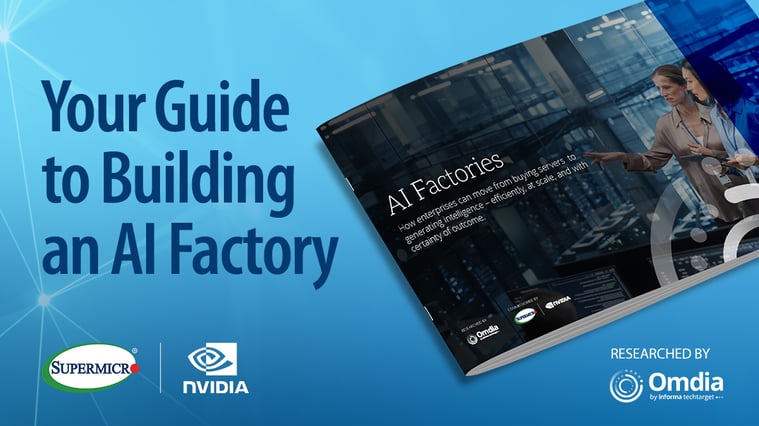
The full eBook, AI Factories: How Enterprises Can Move from Buying Servers to Generating Intelligence, provides the research, insights, and practical considerations behind this transformation.
Developed with independent research from Omdia and in collaboration with Supermicro and NVIDIA, the eBook explores what is changing inside the data center—and what technology leaders should consider as they move AI from the lab to production.

Subscribe to Data Center Stories
By clicking subscribe, you consent to allow Supermicro to store and process the personal information submitted above to provide you the content requested.
You can unsubscribe from these communications at any time. For more information on how to unsubscribe, our privacy practices, and how we are committed to protecting and respecting your privacy, please review our Privacy Policy.