

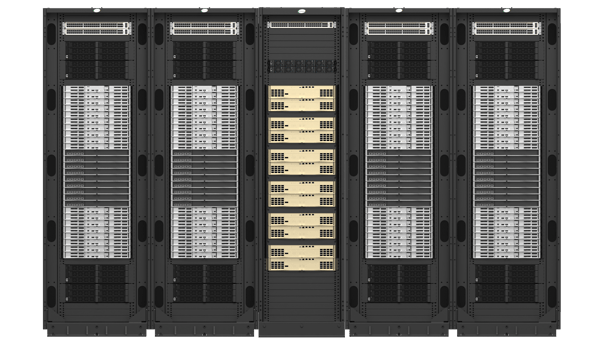
As AI workloads scale toward hundreds of thousands of GPUs, the networking layer has become one of the most critical and most constrained parts of the infrastructure stack. Power consumption, reliability, and deployment complexity all become harder to manage at scale. NVIDIA's new co-packaged optics (CPO) technology, built into the Spectrum-X™ Ethernet Photonics and NVIDIA Quantum-X InfiniBand Photonics switches, addresses these challenges at their root. Supermicro is integrating these switches as part of our Vera Rubin NVL72 and Rubin NVL8 platform solutions — delivered through our Data Center Building Block Solutions (DCBBS) framework — and this post explains what that means for organizations planning their next AI infrastructure build.
|
5X Better network power efficiency |
5X Longer AI uptime |
1.3X Faster time to deployment |
What Changes with NVIDIA's Photonics Switches
Traditional AI networking relies on pluggable transceivers — external optical components that convert electrical signals to light at every connection point. At scale, they add up fast: a 128,000-GPU data center requires 655,000 of them, consuming significant power and failing, on average, every four days. Each failure risks interrupting training runs that may take weeks to complete.
NVIDIA's CPO technology integrates the optical engine directly into the switch package, eliminating the need for pluggable transceivers entirely. The result is a networking architecture that uses over 70% less power, experiences far fewer failures, and is meaningfully simpler to operate. For organizations running sustained AI training or inference at scale, these aren't incremental improvements — they change what is operationally feasible.
What Supermicro's Support Means for Your Deployment
Supermicro's role is to make these new capabilities accessible and deployable — validated, integrated, and ready to run in production environments. Through our DCBBS framework, we design compute, networking, storage, and liquid cooling as pre-validated building blocks that work together as a complete system, rather than components your team must assemble and verify independently. Here is what that looks like in practice for NVIDIA Vera Rubin deployments:
Pre-Validated Building BlocksDCBBS delivers NVIDIA Vera Rubin NVL72 and Rubin NVL8 systems together with NVIDIA Photonics CPO-based switches as a pre-integrated rack-scale solution — reducing the validation and bring-up work required before you can run production workloads. |
Unified Liquid-Cooling ArchitectureNVIDIA Photonics switches are fully liquid cooled, and Supermicro's DCBBS designs the entire rack — compute, networking, and cooling infrastructure — as a single thermal system. This eliminates the complexity of managing separate cooling loops and simplifies data center operations at scale. |
More Power Available for ComputeCPO reduces network power draw by over 70%, which directly frees power headroom within your facility for additional GPUs or future expansion — without changing your power infrastructure. |
Scaling AI Infrastructure That Works at Production
NVIDIA's Spectrum-X Ethernet Photonics switches represent a meaningful step forward in how AI networking is built and operated. For teams planning Vera Rubin deployments, the combination of CPO-based networking and Supermicro's DCBBS platform is designed to reduce deployment friction, lower operating costs, and provide the reliability that sustained AI workloads require. By delivering compute, networking, and liquid-cooling as a pre-validated, rack-scale building block, DCBBS removes much of the complexity that typically slows down next-generation infrastructure deployments.
We are committed to continuing to support the latest NVIDIA platforms and helping customers deploy each generation of AI infrastructure with greater speed and confidence.
Subscribe to Data Center Stories
By clicking subscribe, you consent to allow Supermicro to store and process the personal information submitted above to provide you the content requested.
You can unsubscribe from these communications at any time. For more information on how to unsubscribe, our privacy practices, and how we are committed to protecting and respecting your privacy, please review our Privacy Policy.